
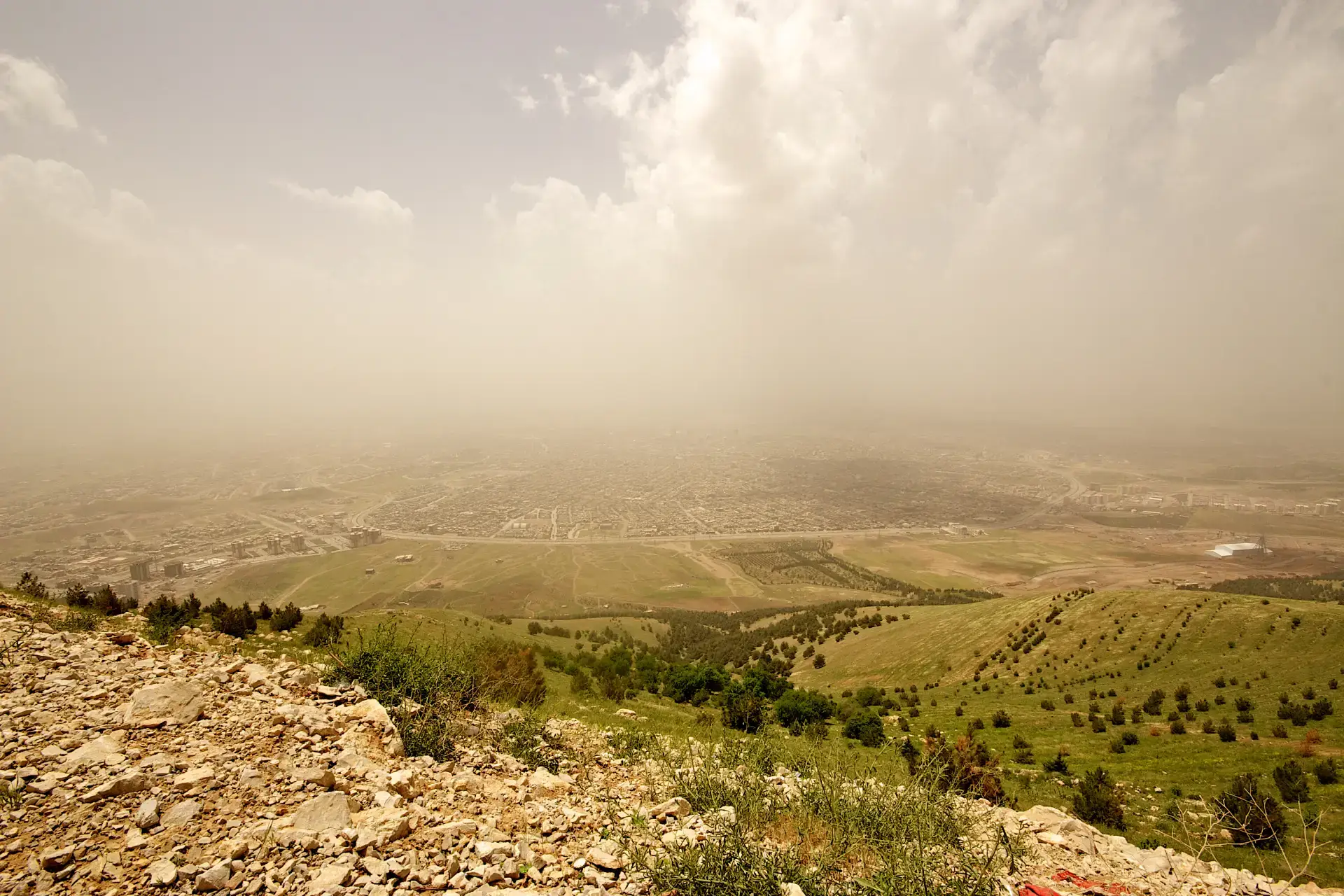
This is the data your protection decisions should be built on – for your people, your assets, and your operations.
You're the person who decides whether staff move into an area or stay put. Whether a site needs round-the-clock security or one guard at the gate. Whether to route a convoy through a province or around it.
You make those calls every day. And they're only as good as what you're looking at when you make them.
Most platforms give you whatever their system pulls in. We don't. Nothing reaches your feed until a human has verified it.
You won't open your feed to find out it's going to be hot in Baghdad this summer. Other platforms publish that kind of thing alongside security incidents because there are no humans in the loop – no one verifying or standing behind the quality of what goes out – so you end up scrolling through noise to find what matters.
Everything on our feed has been checked for relevance by a person before it reaches you. If it's not something you'd act on, it doesn't get through.
Each incident is assessed for its operational significance, connected to the wider picture, and written up with the context you need to act on it: severity, method, target, actor profile, credibility rating, and what it means for the area.
Most platforms give you two lines and leave you to work out the rest yourself. We give you a full page on every incident, because the person deciding whether to move staff into Karbala tomorrow needs more than a headline.
Every incident shows where the information came from. Source reliability and information credibility are rated separately – so you know what's confirmed, what's probable, and what's single-source.
We're the only platform that does this.Scan the feed, check the map, build a chart, or ask a question directly – whatever the moment needs.
Show all High severity incidents within 25km of Baghdad city over the last 10 days, with a trend update against the prior 30-day baseline.
15:45Following a review of the tactical activity within a 25km radius of Baghdad over the last 10 days, one High-severity incident was identified.
Massive GPS jamming was detected across Iraq, Iran, Kuwait, and the UAE, indicating active electronic warfare preparation. Heavy interference was specifically noted in western Iran (Kermanshah and Lorestan, where missile base locations are concentrated) and across Kuwait and the northern Persian Gulf, suggesting a wider regional posture adjustment rather than a localized disruption in Baghdad.
Conterra Assistant is AI and can make mistakes, please check all responses.

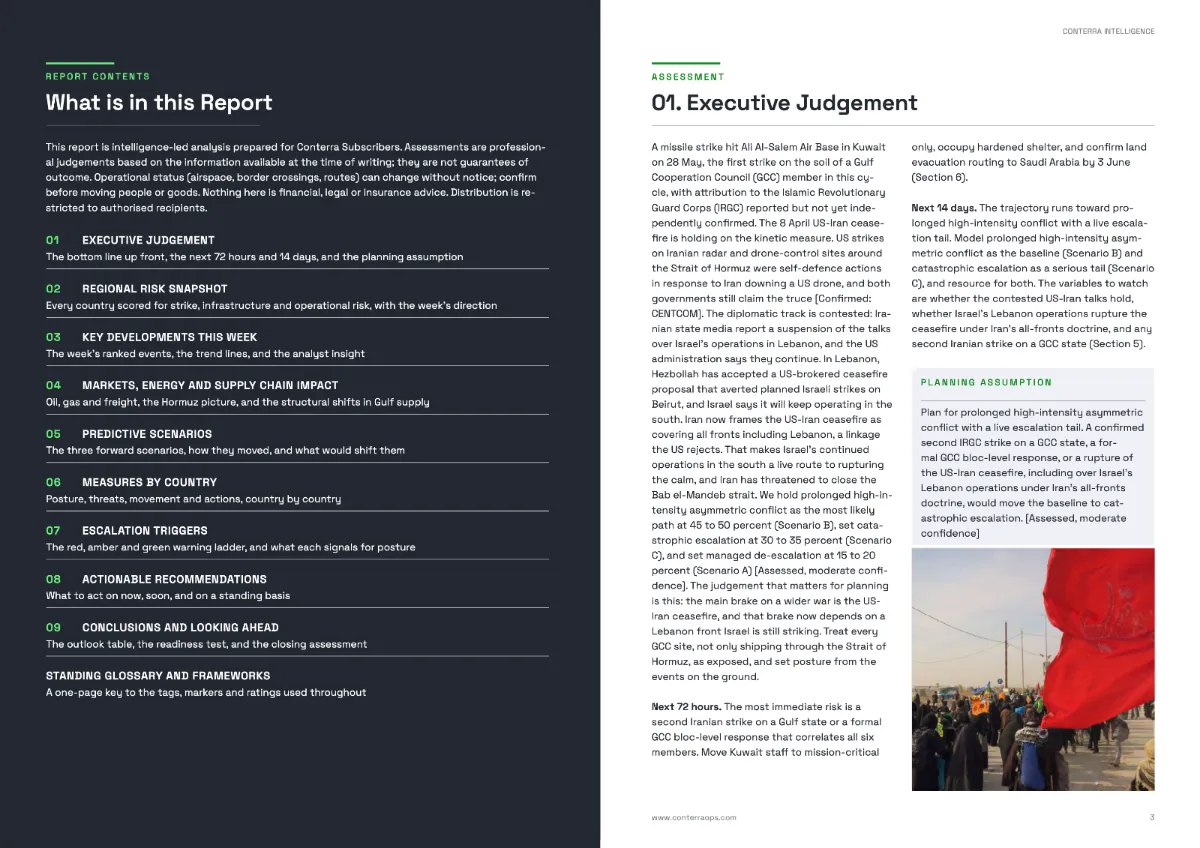
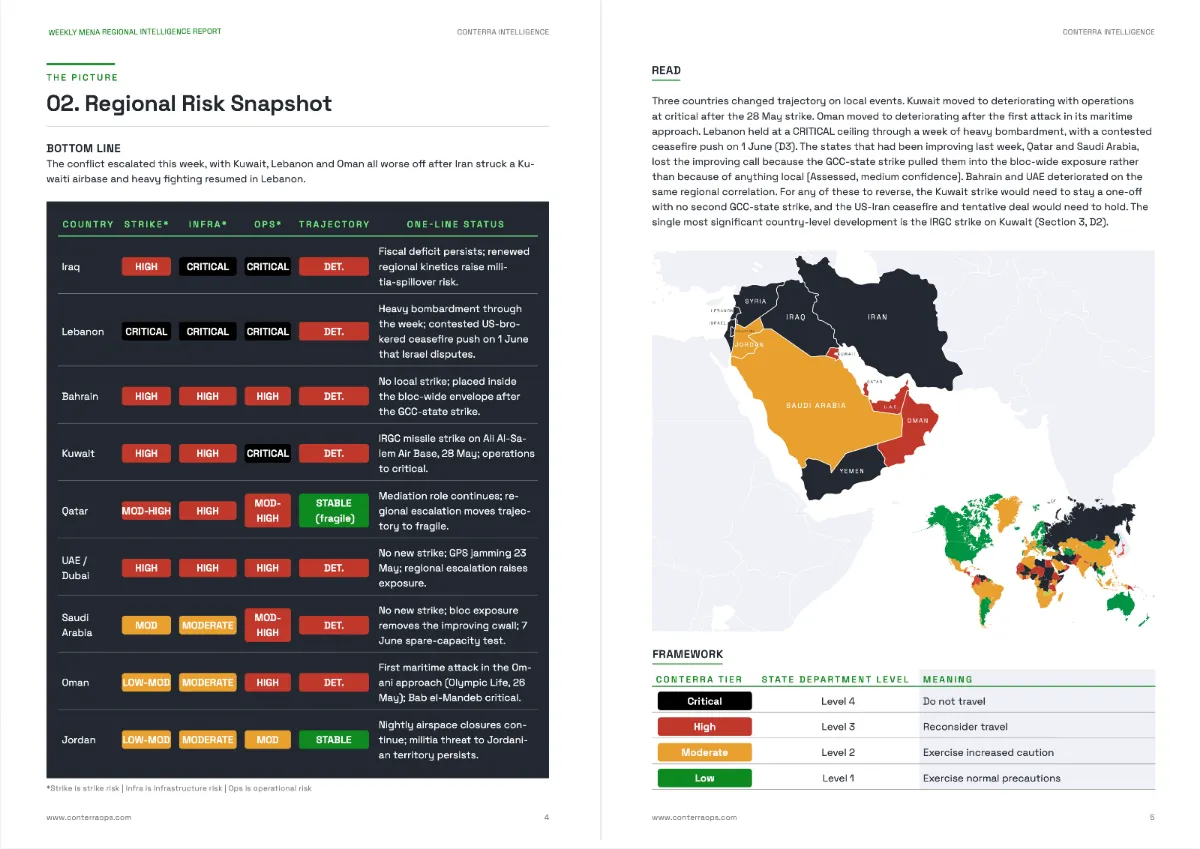
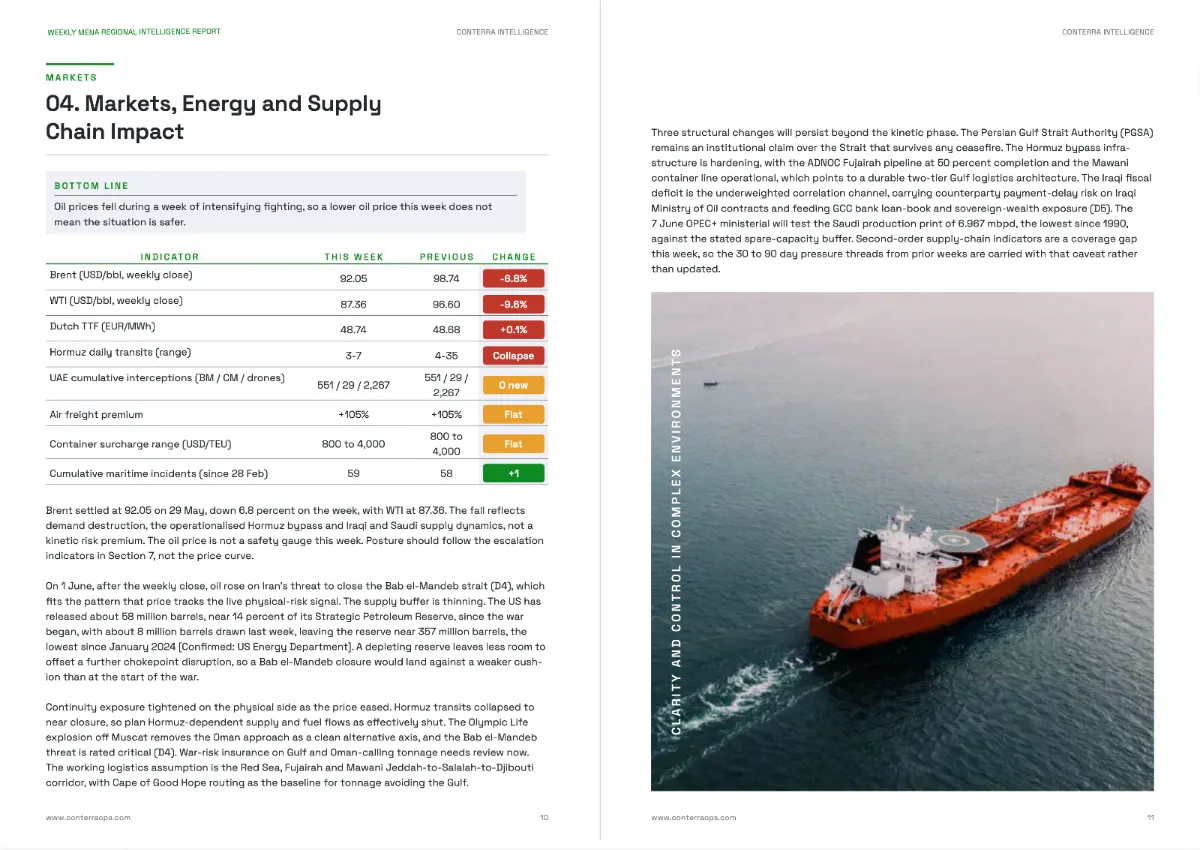
We cover more incidents across Iraq than any comparable platform, drawing on hundreds of curated open-source feeds monitored continuously – local news, government channels, social media, security reporting. When we find a gap in our coverage, we close it. That's not a one-off exercise. It's how the team works, every day.
Most platforms are either fast and noisy – publishing everything that lands on a Facebook page – or curated but thin, with a small team manually scanning a handful of outlets. We don't think that's a choice you should have to make.
Severity. Method. Target. Actor. Location. Every incident is broken down into the fields you need when you're assessing a situation or building a report – not just tagged with a label. Most platforms don't show you how they categorised an incident. You click it and get a paragraph. That's it.
We maintain a network of sources on the ground in Iraq, providing information that never reaches open-source channels. Some of what matters most to your operation won't appear on any public feed. We have people who make sure it still reaches you.
The incident feed, the analytical weekly reports, the statistics, the map, the query tool – it's all in the subscription. You won't get three months in and find out the reporting is a separate product, that sharing access costs extra per seat, or that the export you need is on a higher tier.
Global platforms cover Iraq. They'll give you the car bomb, the significant attack, the political crisis – the things that make international news. They won't give you the rest.
They won't give you the military operations, the local protests, the fuel shortages, the infrastructure failures, the militia movements – the stuff that doesn't make headlines but changes the security picture in the province your people are working in tomorrow morning.
That's the data operational decisions depend on. And it's the data top-down platforms structurally can't provide, because they're built to cover everywhere at surface level, not one place at depth.
We went the other way. We built the platform around Iraq from the ground up – local sources, in-country networks, analysts who know the region, and the depth to track what's happening at province level, not just country level.
If you need a pin on a world map that says "incident in Iraq," there are platforms for that. If you need to know what's happening in Diyala this week and what it means for your operation in Basra, that's what we built.
Iraq is where we started because it's where depth matters most and surface-level coverage fails hardest. It won't be the only country we cover.
But we won't add a region until we can cover it at the same standard – the same sources, the same verification, the same depth. We'd rather be the best in one country than average in twenty.
Our founder has spent nearly two decades managing security operations across the Middle East, including years on the ground in Iraq – where the relationships and sources that power this platform were built.
We used the existing platforms for years and knew exactly what they were missing. So we built the one we wanted to use.
The software is built by a team that has designed and shipped complex digital products over decades – including tools for the UK military, central government, and the NHS.
The combination matters: a properly engineered product, built by people who build products professionally, informed by someone who's lived the operational problem.
Conterra has replaced two intelligence subscriptions we previously relied on. The combination of incident monitoring, analyst reporting and operational relevance provides a level of value that made continuing multiple subscriptions unnecessary. It has become an important part of our daily operations.
 AMS, Iraq
Real incidents, real reports, the full picture. It takes thirty minutes. Or, if you'd rather start with the reporting, download a sample weekly report first and see the depth for yourself.